
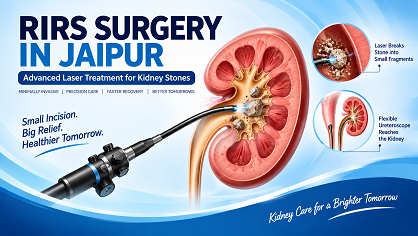
If you are searching for RIRS Surgery in Jaipur for kidney stone treatment, modern minimally invasive techniques can offer an effective alternative to traditional surgery in appropriately selected patients. RIRS (Retrograde Intrarenal Surgery) is an endoscopic procedure in which a flexible ureteroscope is passed through the natural urinary passage to reach the kidney. The stone can then be fragmented with a laser and, when appropriate, stone fragments can be removed.
Dr. Neeraj Agrawal, MS, MCh (Urology), Professor & Unit Head at SMS Hospital Jaipur, is an experienced urologist with expertise in kidney transplant, prostate and urinary diseases. Patients looking for a Best Urologist in Jaipur can consult a qualified specialist to determine whether RIRS is appropriate for their kidney stone.
What Is RIRS Surgery?
RIRS stands for Retrograde Intrarenal Surgery. It is a minimally invasive procedure primarily used for selected kidney and upper urinary tract stones. A flexible, small-calibre scope is introduced through the urinary tract and guided into the kidney. The stone is visualized directly and can be fragmented using laser energy.
Unlike procedures that require an external incision, RIRS reaches the kidney through the natural urinary passage. However, the suitability of RIRS depends on factors including stone size, location, number, kidney anatomy and the patient’s overall health. RIRS Surgery in Jaipur
When Is RIRS Recommended?
A urologist may consider RIRS Surgery in Jaipur when a kidney stone is unlikely to pass naturally or requires active removal. RIRS can be particularly useful for selected renal stones and stones in locations that can be reached with a flexible ureteroscope. The decision is normally based on imaging and a detailed clinical evaluation.
Patients may undergo ultrasound or CT imaging along with urine and blood investigations before treatment. These tests help the urologist understand the stone’s size, location and urinary tract condition.
Benefits of RIRS
For suitable patients, RIRS can provide several advantages:
- Minimally invasive treatment
- No external surgical incision
- Direct visualization of the kidney stone
- Laser fragmentation of the stone
- Useful for selected renal stones
- Potentially shorter recovery compared with more invasive procedures
RIRS is not automatically the best procedure for every stone. Larger or complex stones may require other approaches such as PCNL, while some smaller stones may be managed with observation or medication. RIRS Surgery in Jaipur
RIRS Procedure and Recovery
RIRS is generally performed under anaesthesia. The urologist carefully advances the flexible ureteroscope through the urinary tract to the kidney and identifies the stone. Laser technology can then break the stone into smaller fragments. A temporary DJ stent may sometimes be placed to support urinary drainage and healing after the procedure.
Recovery varies according to stone burden, the procedure performed and the patient’s overall health. Your urologist will provide individual instructions regarding medicines, hydration, activity and follow-up. RIRS Surgery in Jaipur
Why Consult Dr. Neeraj Agrawal?
Dr. Neeraj Agrawal – MS, MCh (Urology), Professor & Unit Head at SMS Hospital Jaipur has expertise in kidney transplant, prostate and urinary diseases. When considering RIRS Surgery in Jaipur, specialist assessment is important because the appropriate treatment depends on the patient’s individual stone characteristics.
A consultation can help determine whether RIRS, URS, PCNL, medication or observation is the most suitable approach. RIRS Surgery in Jaipur
Conclusion
RIRS Surgery in Jaipur is an advanced minimally invasive option for selected kidney stones. By using a flexible ureteroscope and laser technology, stones can be treated through the urinary passage without an external surgical incision.
If you are experiencing recurrent kidney stone pain, blood in urine, urinary difficulty or repeated stone formation, consult a qualified urologist for proper evaluation. Dr. Neeraj Agrawal, MS, MCh (Urology), Professor & Unit Head at SMS Hospital Jaipur, can evaluate your condition and recommend an appropriate treatment plan based on your individual needs.
